

Snieguolė Michelkevičiūtė. A Woman about Men
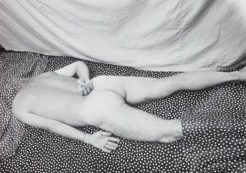
The photographs of Snieguolė Michelkevičiūtė contradict the conventional perceptions of our world. We look to artists whenever we want to be provided with an unconventional take on life, but when it’s a woman who’s in charge of a revolution, the audience might feel slightly uncomfortable. The act is like a space with mines all over the floor, in a political and erotic sense. The form of the act itself was shaped when the canons of western art were in their initial stages, and now it flourishes in our contemporary culture, bursting also into the field of interest of Snieguolė Michelkevičiūtė. Men dominate this genre of art, like in all Lithuanian photography. “Men look at women. Women watch themselves being looked at,” John Berger stresses in his book Ways of Seeing. Observing Michelkevičiūtė’s photos of naked men throughout the years since 1977, Berger’s statement should be rewritten: “Women look at men. Men watch themselves being looked at.” She crushes the patriarchal cliché of showcasing a young, slim, and approachable body of a woman, changing the perspective in her photos: Zuzana secretly watches old men bathing, and Diana looks at Actaeon.
The male act can easily be turned into a scandal – it’s a sensitive and ambivalent matter. If it finds its way into photography, especially in the second half of the 20th century, it’s mostly associated with homoeroticism and the queer movement. Michelkevičiūtė breaks this rule too by bringing the male act back in front of a female gaze. The men in the photos are handsome, no matter what their age or body proportions may be. Even when photographing young men, the artist favours their gentle and sensitive side. She steps away from triumphant, symbolic poses characteristic of academic sculptures or paintings; she rejects Belvedere’s Apollo and Hercules, focusing on the details by shooting from up close. Unlike the photographers of canonical queer images, such as Robert Mapplethorp, Herb Ritts and Matthias Hermann, Michelkevičiūtė doesn’t care about erections, firm buttocks or the contours of the muscle veins. If a penis can be seen in one of her photos, it’s typically flaccid, with absolutely no need to prove its masculinity. That doesn’t mean it’s not erotic – on the contrary, the artist is very much interested in the body and touch. Raminta Jurėnaitė writes about the works of Michelkevičiūtė noting that the artist opposes Lithuania’s catholic society. The critic is probably right, because even a person who doesn’t understand photography at all will notice the uniqueness of her take in a genre completely dominated by strong men. However, her tone does lack a certain revolutionary, fierce and feminist feel. In other words, these wonderful black-and-white photos would almost be impossible to include in the movement of Eastern European feminism, as her works don’t reflect the fight against the patriarchal system – they’re more an affirmation of masculinity without pornography, revenge, disgust or wickedness. However, it’s still intriguing to look for parallels with strong Lithuanian female artists such as Jurga Ivanauskaitė, author of the iconoclastic novel “Ragana ir lietus” [The Witch and the Rain] (1993).
Raminta Jurėnaitė compares Snieguolė Michelkevičiūtė with Jan Saudek. It’s an interesting comparison, but not an entirely accurate one. The Czech photographer plays with the artform by staging scenes full of kitsch with women of various ages (including underaged girls) taking part, while Michelkevičiūtė takes her models and the act of photographing them very seriously. Saudek-style works are usually drenched in cheap erotica and rough Czech humour, both of which are alien to Michelkevičiūtė, who speaks about transience and beauty while trying to portray the most emotional things, avoiding easy-to-grasp associations with the particular artistic poverty that’s specific to Saudek’s art. Her “blurry” photos are much closer to the compositions of painter Francis Bacon. Even though props like masks, birds, ropes and curtains appear in her photographs, these objects are difficult to interpret as having just a single meaning. She creates series, photographic tales, entire stories, but the structure of her works is much more like that of poetry or free verse rather than a folk novel. The session of photography here includes images being divided into gestures, glances and visions in order for them to reappear later in the spectator’s mind as reflections of the artist’s imagination, erotic fantasies and sensitivity.
Of course, the art of Snieguolė Michelkevičiūtė also finds common ground with works by other artists, not just Saudek. The ambivalent, graphic and ruthless stare of the Lithuanian artist is typically more characteristic to male artists – this makes her a certain pioneer in her category. But her photographs are much more intimate and beautiful than those by Boris Mikhailov, Rimaldas Vikšraitis or Tomislav Gotovac, all of whom took pictures of themselves. Sensitivity and seriousness make Michelkevičiūtė’s creations contradict irony, absurdity and playful distance, whereas the men taking photographs of themselves use these notions to hide behind. Perhaps her studies of the male body are closest to the self-portraits of John Coplans. Her images are minimalistic and sincere, as she creates laconic, lyrical narratives based on real events, experiences, emotions and other elements, whether visible or invisible (like emotions or fantasies).
Michelkevičiūtė doesn’t shy away from allegories. Her photos can be linked to historical context, value crisis, the end of the Soviet Union, also to the restoration of Lithuania’s independence. It’s easiest to notice all this in a series of photographs that show an older man with a disappointed face. He is Sisyphus, still handsome and powerful, fighting a workload that’s unmanageable for him, pushing a Soviet locomotive and trying to climb on it. This is the negative of the famous photograph by Arkady Szajchet, where a young socialist-realist half-god is introduced, a Stakhanovite from the factory of Balakhna, standing behind a valve that looks like a wheel. Michelkevičiūtė creates allegories of life, but her art is at its most exciting when you delve into separate photos instead of examining the artist on a general content level. If we were to talk about the theory of the male act, which researchers in queer and gender studies usually prefer to do, we would have to speak about Michelkevičiūtė’s aim to recreate beauty and pathos, gentleness, the sensitivity of men’s bodies, and finally a man himself. Repetitive and dragged-out exhibitions create many contexts, harming the balance of an image, problematising photography as well as the male figure. The artist looks for a new description of a man, not a heroic political, religious or mythological allegory, pointing just to sexuality and the body. This is a revolution based on an innovative glance and on a political hierarchy of the sexes.
A text decorated with such beautiful photographs shouldn’t just politicise or theorise, it should open new contexts to the readers and offer an extension of literary photography. There’s something in common between the works of Michelkevičiūtė and Miliauskaitė, and that “something” steps beyond the experiences of a single generation and the complicated relationships between men and women that go with it. It’s worth proving this by citing a poem by Milauskaitė from the selection “Uždraustas įeiti kambarys” [The Forbidden Entrance Room]:
I close my eyes
so calmness could cover me
then – I know – you’ll give
a piece of paper to me,
white as snow
you’ll put black ink
in front of me
and my hand will
paint the words
but I myself am a
blank piece of paper –
learning to read
the hieroglyphics anew
the ones you leave in my soul
when you’re smiling
When Sienguolė Michelkevičiūtė takes a photograph, the image becomes a white, blank piece of paper, a snowy field if you will. Dark, deep colours interact with contrasting transitions, the texture of the skin, and the wrinkles that hang inertly on the body – all of them shape a new set of symbols. The artist smiles and paints the hieroglyphics in our souls, while we’re learning to read them.


