

Anamorphic Games of Slides: The Catalogue
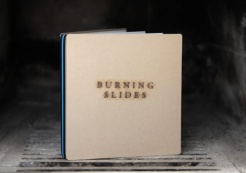
Aurelija Maknytė, Burning Slides, Vilnius: NoRoutineBooks, 2016
Natalija Arlauskaitė
While introducing Aurelija Maknytė‘s book "Burning Slides" ("Degančios Skaidrės") at this year‘s Nida Art Photography Symposium, the publishers Gytis Skudžinskas and Vilma Samulionytė mentioned that it is different from the other “NeRutina“ books because it was published as a catalogue. The decision and the name that was given to it can be considered to be a metaphor, but can also be taken at face value – as a reference to reading and working with slides.
Each page of the book represents a single slide: they are usually anonymous but created not by artists or institutions (by travel agencies, for example), but by private people, and belong to an unknown or a lost home archive - found or purchased. Finally, they have been "burned" – their surface is melted and therefore deformed. The book / the catalogue reproduces these burned slides in real size, their image has been varnished, so, visually, it is a small slide, that, with its sheen, “surfaces” at the centre of the page.
Usually, a catalogue reproduces the work on a smaller scale. In this case, it conveys the object’s materiality in a very precise, accurate way so that it raises a series of questions about the scale, genre, authorship and the conditions of its “fulfilment”. It is also about where and how does the longing for “museum” type of art is let out through contemporary art practices.
The scale is the essential thing in this book. Slide as an object is not yet an artwork, it needs to be "unpacked" on the screen, a wall, any surface that allows it to be enlarged a lot of times. This is what the artist does during the projection performances in galleries, the courtyard of her house in Vilnius or near the Nida Lighthouse, directly on the round red brick wall. The radical alteration of the size is a condition for the image to appear. In addition, the expected, desired image is not fixed (like in a photograph), but temporary, dependant on the rhythm of the cylinder that is displaying the images. The image is enlarged not in order to survive, but on the contrary - to act as an optical trick, which is replaced by a new unpacked slide.
Once they are in the book / catalogue, the images of the slides are not reduced copies of unpacked images - they do not exist yet, and what we see can even hardly be considered to be a hint of them. The "radical" change in the scale is an important word. It describes the change in the relationship between the miniature object and the very large artwork, which fundamentally changes the meanings of the images, for example, the genre.
For the artist, it is important to think about the genre. She has said that melting together reproductions of portraits and paintings turns out to be boring, while melting together landscapes and florals – good: as if breeding new species. The genres slide over the “original" burned slide format, becoming hardly recognizable and often coming close to miniature abstractions, in which recognizable shapes occasionally reveal themselves. They appear and are and immediately "weirded" because of the melted surface after they are unpacked on a vast plane.
Because of these features, the slides, especially the "burned" ones, as objects and temporary images, analogically work by anamorphoses. If anamorphic images (from Hans Holbein’s skull in "The Ambassadors" to William Kentridge’s anamorphic animation) require changing the viewing angle, i.e., the perspective, to see the correct image, these slides require a different deviation from the form (anamorphic motion): the genre and the potential for its “weirding” depends on the size. And the intense efforts of the visitors to reconcile these two images – the existing and the future ones. In a sense, it is even higher than in the case of anamorphic reading, because the viewers in Aurelija Maknytė’s slide performances are directly involved in the deformation of the surface of the slides, cheerfully "burn" them, and thus work with the genre logic of the slides already in the stage of their secondary development from anonymous raw material: they look for the light source and, in the slides belonging to them, try to discern the future unpacked image together with the possibilities for its deformation.
Those who participated in these sessions know that, firstly, you are given a selection of slides, and then you melt them in any way you want. Both the choice and the assessment of the final outcome takes place with the genre and generally "high art" frames in mind, no matter how ironically it is done. While selecting the slide for burning and assessing its potential to be displayed, the future image is perceived as their own work and the final result is discussed like a canvas. Here are a few cues from slide burning next to the Nida Lighthouse:
- I can see that I already have a signature style.
//
- This is my artwork.
- I thought so.
//
- This one is a classic.
It seems this is a condition for the melted slides performances - the genre has to be recognized and immediately ironically transformed, and the genre game is only fulfilled by creating a temporary museum of gigantic light canvases. An urban landscape is worth of display if, after melting it down, there is something similar to a swarm of bees hanging over the city. Floral still life - if the "burning" allows it to mutate. Tourist images – if the monumentality of the memorials is offset by an oddity created by the flames. In other words, the genre game occurs if, when the image is radically enlarged, the collision of genres brought on by the visual deformations is emphasized: the connections between landscape and horror movie iconography, still-life and catastrophic images. The artist has mentioned that children who take part in such performances burn the slides up to the frame and for them, it is like creating war and explosion.
This museum-like character of slide deformation, display and cataloguing, was the axis of the previous artwork "The History of Art According to the Father" (2014). That time, a family - father - slide archive of artworks was displayed, and its exhibits have changed over the time – they have become or are becoming monochrome. Introducing the work, Maknytė writes: "In terms of colour, they remind one of the potassium permanganate solution or the cover of the Lithuanian Soviet Encyclopaedia, on the volumes of which the projector used to be placed."[1]
Therefore, the cataloguing impulse emerges not only in the direct naming of numbered paintings and other objects but also a more encyclopaedic flair to archive all surrounding world, however Borgesian such an encyclopaedia would be: made up of giant Nicolas Poussin’s canvas with pastoral or mythological subjects, at first compressed into a slide, and then, after it becomes old and faded, unpacked on the wall of the gallery (as in "The History of Art According to the Father"), or of images snapped by an unknown person - melted and enlarged to Poussinian scale, just as museum-like and mythical.
“Burning Slides”, as a book, suggests a museum-like anamorphic genre game - guessing what the image could become once its scale is transformed: a disaster landscape, mutant-plant still life, touristic postcards from cities struck by aliens or a nuclear explosion - almost all of them emerge from the tangle of abstract shapes and colours. Slide "burning" as a performance is a test to the genre imagination, requiring it to assess the double image deformation - (anamorphosis) by the scale and by the fire, the temporary museum and the flexibility of the genre.
[1] Aurelija Maknytė, personal internet website, http://maknyte.com/meno-istorija-pagal-teva-2014/ [accessed 2016-11-02].


