

The Classics of Lithuanian and Latvian Photography in Prague
2016 09 13
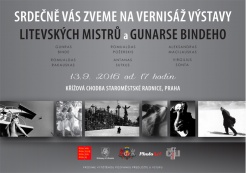
On the 13th of September the opening of the photography exhibition The Best of Lithuanian Photographers and Gunars Binde will take place at Prague’s Old Town Hall, in Cloisters and Knights’ Hall. Visitors will have the opportunity to see the exhibition in a very heart of Prague’s Old Town till the 9th of October.
Tomas Pabedinskas
The works presented in the exhibition come from Antanas Sutkus’ (b. 1939) photography series People of Lithuania, Aleksandras Macijauskas’ (b. 1938) series Markets of Lithuania, Romualdas Rakauskas’ series Blooming (b. 1941), Romualdas Požerskis (b. 1951) photographic narrative about a village dwarfLittle Alfonsas and Virgilijus Šonta‘s (1952-1992) works from his various photographic series. In addition to the works of Lithuanian masters the exhibition presents the best works of Latvian photographer Gunars Binde (b. 1933).
Aleksandras Macijauskas. Rural Market
Organized by Garik Avanesian, a curator and publisher living in Prague, the exhibition extends the long-term tradition of collaboration between the two countries in the field of photography. During the Soviet years, Revue Fotografie, a magazine published in what was then Czechoslovakia and also available in Lithuania, helped Lithuanian photographers behind the Iron Curtain to improve, while Czech publishers and photographers (Daniela Mrazkova, prof. Vladimir Birgus, prof. Ludvik Baran), took care of dissemination of Lithuanian oeuvre in the Western world. Already in 1969, the aforemefntioned Czechoslovakian photography magazines published A. Macijauskas‘ work and later presented three other Lithuanian photographers.
Antanas Sutkus. Marathon
The presentation of G. Binde’s works in the exhibition also is not accidental. This author has long-term and close relations with Lithuanian photography. Already since 1960’s G. Binde participates in the creative and organizational activities of Lithuanian photographers’ community. Between 1961 and 1963 he studied the photography course led by Povilas Krpavičius – famous interwar Lithuanian photographer – at the House of Journalists in Moscow. The beginning of G. Binde’s personal creative and human friendship with Lithuanian photographers is marked by the first exhibition organized by Kaunas Photo Club at the Kaunas Historical Museum in 1965, when G. Binde helped the organizers and the authors of the exhibition to defend their creative freedom form the ideological criticism of the Soviet functionaries.
By that time G. Binde had already become the icon of Latvian photography and famous author in all Soviet Union. The works presented at the exhibition reflect the creative features of his works, which were formed at that time and later decades: aesthetic, but also psychological and dramatic nudes, the combination of the forms of a female body and nature, focus on the humans’ relations to nature revealed through visual metaphors.
Gunars Binde
Lithuanian authors present their most famous works, which characterizes their individual style and at the same time gives the opportunity to foreign viewers to get acquainted with School of Lithuanian Photography as the general creative movement. The formative authors of the school present their works, which has become icons of Lithuanian photography: village grandmothers under falling petals by R. Rakauskas, a girl nesting by her mother‘s arm observed by A. Sutkus (Mother’s Hand, Vilnius, 1966), a village trader with a piglet pictured from an unusual angle by A. Macijauskas (In the Lithuanian Markets, Kaišiadorys, 1969), and so on.
R. Požerskis’ works represent the continuity of the traditions formed by the older colleagues. Visual metaphors and philosophical ideas inherent in Lithuanian School of Photography reveal itself clearly in his series Little Alfonsas. Such works attract the viewers’ attention not only because of their artistic quality, but also because of clear visual metaphors. These are the most obvious in R. Požerskis’ works, where Little Alfonsas is immortalized in situations preconceived and staged by the photographer. The character, walking down the beach with a young woman invited to take part in the photoshoot, certainly highlights the contrast between the ideal and happiness as a goal, and reality which is often imperfect and painful. In other photographs, the destiny of Little Alfonsas is symbolized by the images of the Hill of Crosses, while his humanity – by warm interaction with domestic animals. In such kind of photographs the moment of life turns into the general idea, related to the praising of “simple” life and humanism.
Romualdas Požerskis. Little Alfonsas
One can easily recognize these attributes of Lithuanian School of Photography in the works of V. Šonta, a comrade of R. Požerskis. It is particularly clear in the photographs from the series School – My Home (1980-1983) about the boarding school for disabled children. Psychology, emotions and human relationships among the residents of the school are revealed in the photographs. On the other hand, V. Šonta’s works add his individual and peculiar touch to the presentation of Lithuanian photography in Prague. Male nudes, the “objectification” of naked body in the series The Feeling of an evening (1990) are all distinctive features of this author’s oeuvre. Meanwhile V. Šonta’s works of other nature – dynamic and of modern aesthetic – reveal the diversity of his creative work.
Virgilijus Šonta. School – My Home
In the international context the works represented in the exhibition relate to the humanist photography trend, which reached its peak in the middle of 20th century in Western photography and has influenced Lithuanian photographers, who made their creative debut at that time. The most important thing in this photographic tendency as well as in Lithuanian School of Photography was the reflection of universal human experience and the possibility for the viewer to recognize his own experience in it.
Romualdas Rakauskas. Blooming
On the other hand, in the Lithuanian authors’ works the international humanistic photography trend has gained a unique aim, formed by historical circumstances, to preserve national Lithuanian identity and culture by recording traditional way of life in Lithuanian villages. In the Soviet era the topic of national identity had a sense of indirect resistance to the contemporary political situation. Nowadays, such photography represents our country‘s culture and history under the circumstances of freedom and charms with nostalgia for the past.


