

MONUMENTS AND everlasting flowers. Biennale Photo Mulhouse
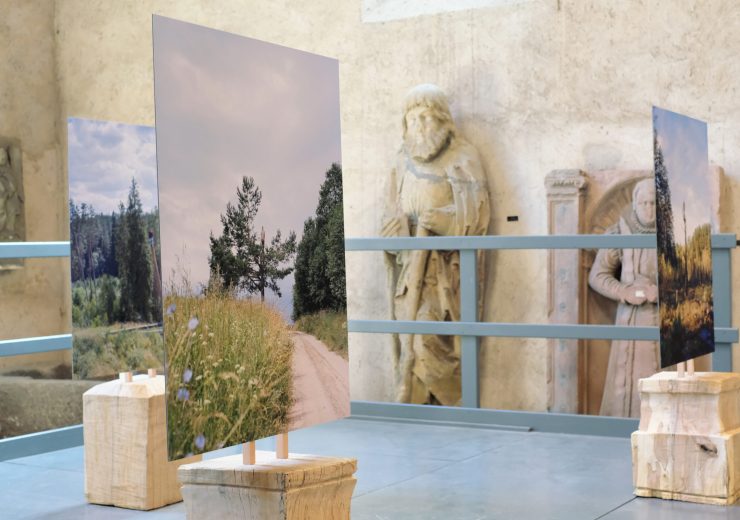
The exhibition “Monuments and Everlasting Flowers” opens on September 14th at 11:00 a.m. at the Saint-Jean Chapel in Mulhouse, France. The exhibition’s authors, Andreij Polukord and Léa Habourdin, are participating. The project is curated by Sonia Voss. The exhibition will run until October 13th. Additional opening events will take place on September 21 at 3:00 p.m. and September 22 at 5:00 p.m.
In an age marked by bleak ecological prospects, the artistic strategies developed by Andrej Polukord and Léa Habourdin activate our imagination and encourage us to reinvent our relationship with nature. Polukord uses performance and photography to evoke the phenomena of massive deforestation and mocks mankind for destroying trees and turning them into pedestals for monuments to its own glory. Habourdin draws inspiration from the discoveries of an 18th-century French ecclesiastical botanist, Desbiey, to reflect on the future of Nida's dunes and forests in Lithuania.
Event organized as part of the Cultural Season of Lithuania in France 2024 and in co-production with Lithuanian Photographers Association and MAC- Mulhouse Art Contemporain.

Andrej Polukord perilously stages himself atop tree trunks abandoned by the operators and poachers responsible for the massive deforestation underway in his country. Taken in medium format, his portraits show him perched like a statue both heroic and ridiculous, denouncing in a humorous and biting gesture the sacrifice of nature by man for his self-satisfaction. He works at the intersection of photography, performance and ready-made. Playing with themes of glorification and sacrifice, Polukord's works resonate with the particular environment of Saint-Jean Chapel.
Andrej Polukord (b. Vilnius, 1990) uses installation, performance, photography and video. A 2015 graduate of the Vienna Academy of Fine Arts, he was co-recipient of the Kunsthalle Vienna Prize in 2016, then invited in 2017 to take part in the Rupert cultural program. Developing unpredictable environments and absurd situations, creating double meanings and ambiguities, he explores themes such as ecology and human activity in nature with humor and a sense of adventure. Drawing also on vernacular cultures and mythological narratives, his creative process blends critique of institutions and self-staging. Andrej Polukord lives and works in Vilnius and Vienna.

French artist Léa Habourdin has long had a special relationship with Lithuania, which she has visited on several occasions. The work presented here is the result of a residency in Nida in the spring of 2024. Inspired by the Desbiey brothers' research on dune fixation (circa 1760-1774), the installation is based on a photograph taken in the dunes of the Curonian Spit, fragmented and printed on Lithuanian linen previously dyed using natural pigments of everlasting flowers, as well as flowers of cosmos, garance and artichoke.
Born in 1985 in northern France, Léa Habourdin first studied printmaking at the Estienne school, then photography at the ENSP in Arles. Attentive to the diversity of life forms, her practice aims to draw other ways of resonating with living things. She observes our relationship with other animals and landscapes, and draws on notions of survival, fracture and reconstruction to compose a narrative around what we call "the wild". Exploring fields such as ethology, applied scientific research and botany, she deploys a body of work in drawing and photography in which the place of the book and the printed object is crucial.


