

There's No Mountain High Enough: An Interview with Margarita Paškevičiūtė
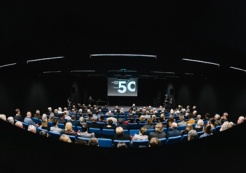
The 50th anniversary of the Lithuanian Photographers Association is a perfect occasion for us to talk with those who contributed to its establishment and development. Margarita Paškevičiūtė is a former exhibition manager who worked in the Association for over three decades.
Could you tells us about how the early days of the then Society of Art Photography?
My acquaintance with photography began before 1969. My uncle Vytautas Bortkevičius, a photographer at the Museum of History and Ethnography of the then Lithuanian SSR, would let me help him in the dark room. This was where I got mesmerised by the mirracle of images appearing on the sheets of paper. He also introduced me to the works of Algimantas Kunčius and Vitas Luckus.
Later on, during my English philology studies, my lecturer offered me to join the newly established Society of Art Photography. Antanas Sutkus invited me to meet him in a newspaper editorial office on the then Komunarų Street (curr. Jakšto Street) because at that time the Society didn't have its own premises. I still remember that moment when, upon arriving, I ran into a man photographing a female nude right in the corridor I was supposed to cross. Astonished by this sight, I stood there until I heard Sutkus' voice: "Move along, go further down please." Although the experience of me squeezing through between the photographer and his nude model in the corridor was not exactly pleasant, I submitted my job application nonetheless.
Soon after we were given an office in the building in Jaunimo Garden (curr. Bernardinai Garden), in the premises of Kultūros barai magazine. There were three of us at that time: Sutkus, the accountant, and me. I eagerly got into work. We worked with great enthusiasm and vigour, and these were the only things that kept us going. I recall how we had to put together the Society statute, but we had no typewriter. Luckily, my father worked in the Ministry of Agriculture, so I kept pesking his secretary to let me use the typewriter during her lunch breaks. This was how we typed out our Society statute. I was confronted with various problems from the very first day, but I persevered because I feltlike I was part of the Society.
Could you tell us more about your work?
We had several lines of work: popularisation of photography in Lithuania and the search of like-minded people in other creative spheres, preferably abroad. The Society Library played a major role. We had no higher education institutions that prepared photographers, and many photographers were journalists. When ordering books from all over the world we didn't restrict ourselves only to the genre of photography. The ordered books needed to be collected from the Technical Library. I remember how I used to carry those huge packs of books tied with a rope which would cut into my hands so painfully that I had to keep stopping everywhere I could. I still recall that little corner frieze at the Vilnius Art Institute (curr. Vilnius Academy of Arts) where I used to sit catching my breath. However, as soon as the parcels reached the Society office, there would always be a bunch of people eagerly waiting for the books, so their excitement would make me forget about my poor hands.
Soon after we were given the rest of the premises with four more offices. We had a corner dedicated for our library, and we had a wardrobe that served as our photography archive. Later, we moved to an even bigger space at 4 Universiteto Street where we had a dedicated library room.
We were trying to convince Vilnius Institute of Art to include photogrpahy as a speciality. There was also the annual Nida Photography Seminar which played a major role in photographic education. Due to the lack of funding, we organised the event during the off-season, and we would usualy have everything crammed into the premises of the hostel "Zunda". We always tried to invite interesting keynotes. Unfortunately we were not allowed to invite foreigners because Nida was considered a border zone area. During the evenings, the art theorist and film & TV critic Skirmantas Valiulis would show us his exclusive sets of rare films.
What was the financial situation of the organisation at that time?
The beginning was rather difficult. All the furniture and cars we had were in bad shape. We once had a situation that illustrates the situation in a rather comical way. Lorenzo Merlo, the director of the "Canon" gallery in Amsterdam, once brought the show "Fantastic Photography of Europe and US" to Lithuania. We had to put some real effort to make this happen, and the show made a huge impact on Lithuanian photographers. According to the security protocols, the guests had to be seated at the back seat, but so it happened that the back doors of our shabby vehicle wouldn't open from the inside. So one day we all boarded the car and went to see the show. Suddenly the car became filled with smoke, and our guest, unable to open the door, started shouting: "Crematorium! Crematorium!" Thankfully, there were no casualties.
Later the situation had improved: new departments were established, more members were admitted to the Society, and we acuired new means to popularise photography.
What were your encounters with censorship?
I once had to run the Society when Sutkus was on his sick leave for half a year. Because we had a tradition to organise the annual Society member show, it was me who had to be responsible for the content. Perhaps, because the photographers realised that I won't be as thorough with the selection of works, they allowed themselves more liberty.
Shortly after the opening of the show I was summoned to the Central Committee for an 'explanation', which was already a bad sign. I was so stressed that day that I still remember the words of S. Šimkus who was a senior official at the CC: "This time Lithuanian photographers had really fallen face down in the dirt". Luckily, because I was still young and inexperienced, the official simmered down and decided not to ruin my career.
Everything was censored all the time. The only means to counter it was by using your skills to convince the censors that artworks can be interpreted in many ways. Yet those govermental restrictions were like stabs to my chest. This was affecting both the individual photographers and the organisation as a whole. We had great photographers like Romualdas Požerskis who believed in a better future and were hiding their more daring works.
I recall another censorship-related situation. During the period of 1985-1987 we had a Dry Law--this meant that the Head of the Society had to ensure there was no wine during the show openings. So happened to be opening J. Kalvelis' show. The audience was reluctant to leave after the opening and wanted to continue debating about the show somewhere else. I called my mother and asked her to make some snacks for the guests. I told everyone that, unfortunately, there was no alcohol in my house. So what do you know, every visitor brought their own bottles! The flat was small, but all the guests have somehow managed to find a cosy spot, so the evening was going well. Then suddenly Sutkus called and announced that he was coming over. We then swiftly got rid of all the alcohol and filled our champagne glasses with mineral water. But Sutkus quickly surmised what was going on and didn't stay long.
What were your biggest achievements in your work with the organisations abroad?
We were aways trying to incentivise our new members. In 1995, during the photography festival in Arles, France, there was a competition "Kodak European Panorama of Young Professional Photography". We did everything we could to send a Lithuanian photographer there. And I'm happy to say that our Artūras Valiauga became a finalist and a prize winner there.
I should also mention the international European advertising festival "Epica". I was invited there as a representative of professional photography. When we had all the itinerary planned, I decided to invite one of our photographers to go with me so they could see the grands of international photography. At that time, Valiauga had launched his own advertising agency and was a perfect candidate. Because we had no additional funding, I cancelled my reservation in a luxurious hotel so we could both stay in a cheap hotel instead. This was not a problem until the moment when I met the organisers of the event who then offered us to go to our hotel and discuss their visit to Lithuania. We didn't dare to invite a Kodak representative to our shabby hotel, so he kindly invited us to his place. This was how I managed to bring Andrew Rawlins, the organiser of "Epica" festival, to Lithuania. This has led to Vilnius Contemporary Art Centre hosting a European advertising and poster exhibition.
As far as the representation of Lithuanian photographers abroad is concerned, I should mention that sometimes it was their wives who played major roles. At that time, good photography studios were rare. Many of them were set in damp cellars. Rimantas Dichavičius was one of the lucky ones who had a proper studio. It was his studio that we would bring our foreign guests to. It was customary to treat the guests with snacks, which was what Dichavičius' wife was so good at. She obviously contributed to her husband's creative success.
What was the most memorable thing from all these years of working in the Society?
I am particularly fond of the 'Youth Garden period', a time when the organisation was still making its first steps. We had to do everything from scratch, and our enthusiasm had no limits. There used to be many arguments during the art council and managerial presidium meetings, but the decision making was never up to a single person, all our strategies were developed through debates. I think this was very important because it encouraged us to be more ambitious and grow.


