

The Days of Censorship: An Interview with Jonas Ramoška
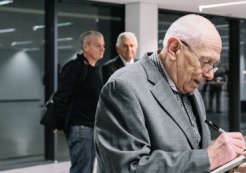
Due to the occasion of the 50th anniversary of the Lithuanian Photographers Association we talk to its former curator Jonas Ramoška about his experiences of working in the organisation.
Could you tell us about how you got involved with the Association? What was the status of photography in the art field of that time?
After the launch of the Society of Lithuanian Photographers in 1969, the ‘virus’ of photography has spread from Vilnius to the rest of the republic. This gave a start to a real frenzy of photography shows. Amateur photographers were eagerly following all the developments in Vilnius. By the way, Kaunas photographers already had their club even before the Association was launched.
At that time I lived in Plungė, and I came up with an idea to organise a group of freelance photo journalists to work for the local newspaper I was employed with. I invited everyone interested in photography, yet I didn't expect to see so many enthusiasts during our first meeting. There was a whole variety of people: schoolchildren, agronomers, engineers, teachers. So we were commenting on each other’s work, putting on the shows, publishing the best photos in the local newspaper, and organising meetings with prominent photo journalists from the whole republic.
My work with the local enthusiasts was inspirational. Encouraged by Bernardas Aleknavičius, who worked as a photo journalist in Samogitia, and endorsed by Antanas Sutkus, the head of the Society of Lithuanian Art Photographers, I decided to organise the photography exhibition “Man and Earth” in Plateliai. Eventually this event had grown into a big annual festival of Samogitian photography. I had a lot of helpers who even worked night shifts, constructing and arranging the open air exposition spaces next to Lake Plateliai. Some years later, when I have already been working with the Photographic Society in Vilnius, I invited the same installation team to help me with setting up the monumental show in Novisibirsk, Russia. We had to stick all the 700 prints onto the plywood and paint the panel backgrounds in a week. We've spent sleepless nights doing this hard and exhausting work. We didn’t have any proper equipment, so we did everything manually. Funny detail: Bronius Gudelis was our ‘press’—he would press the prints against their backings with his own weight.
In 1971, Sutkus invited me to work with the Vilnius Society. They already had their own accountant, secretary, and manager. Vladas Uznevičius, whom I knew from Plungė, was already there under my recommendation. We didn’t shy away from work, we did anything that needed to be done. The beginning was hard. We could only dream about the permanent exhibition spaces. We couldn’t acquire any professional installation equipment simply because there were none. These were the times of deficit, and we had to make do with these heavy (4 mm thick, 60x80 cm) sheets of glass, hand-made hangers, and the threads that would stretch from the weight of the prints. Sutkus kept us busy though, and we would install one show after another. In fact, we used to do more shows than we do today. They were also bigger and more frequent. We used a whole variety of exhibition spaces, including Exhibition Palace (currently Vilnius Contemporary Art Centre; auth.), National Museum, Labour Union Palace on top of the Tauras hill, city cinema theatres, and National Philharmonic. During the summers, the displays at the Palanga Art Gallery were renewed every fortnite.
There was more to our work than just installation of prints. We had to liaison with the authors and coordinate with the organs of power. I should also mention the production of invitations, placards, and posters. For all the significant shows we would order the poster design from professional artists—Juozas Galkus, Vincas Kisarauskas, Alfonsas Augaitis; but sometimes I would even do the design myself. Back then, the printing of even the smallest invitations had to be coordinated with Glavlit (the censorship organ; auth.). There used to be a lot of fussing and running around. They always wanted to appear very important and busy.
At that time the Society began sending prints abroad, particularly for the shows organised by FIAPO. It wasn’t enough to just prepare those parcels and compile the lists of works. Everything needed to be coordinated with the organs. There were no obstacles in the Ministry of Culture. The experts Nina Šimukėnaitė and Viktoras Liutkus would simply flick through the prints and stamp the list with “Approved”. Then we would go to Glavlit. We used to be lucky if we stumbled upon Vytautas Trečiokas, he was not fussy. But the head of Glavlit or his deputy would never miss a chance to reject prints and write lengthy comments about how a soviet person was supposed to look like. They used to find the prints from Aleksandras Macijauskas’ “Bazar” series particularly problematic. They also saw ‘incorrect’ portrayals of soviet people in the works of Vitas Luckus and Aleksandras Dapkevičius. And I am not even talking about nude photography—not a single print would pass.
If I understand correctly, back then the Society had around 100 employees. Could you tells us about how you managed to navigate between your duties and spheres of influence?
Indeed, as the Society started growing, we needed more people to publish and advertise photographic art. A number of new sections started emerging. Apart from Kaunas, we had sections in Klaipėda, Šiauliai, and Plungė. Thanks to Sutkus’ tremendous efforts, the municipal governments were forced to find the premises for these sections.
Then the Society members acquired the possibility to fund their projects through the Arts Council. However, as the Society kept growing, the governmental funding became insufficient, thus we had to create new lines of production. Sutkus assigned the economist Algis Semanavičius as his Deputy, who was then given a task of organising the production. This has led to the opening of the Production Department, which I had a chance to run for a few months. Suddenly there was a lot of work for a lot of photographers in Vilnius, Kaunas, Klaipėda, Plungė, and Skuodas. The Production Department would supply them with commissions and photographic materials. When the silk screen printing workshop got established, it started producing the public safety materials that were distributed across the whole Soviet Union. With financial stability, the Society was now able to help its members by, for example, providing them with photo materials. This was not easy though. There wasn’t much you could get at the National Supply Centre because of the limits set by the Planning Committee. Therefore we sought direct connections with the factories in Kiev, Leningrad (curr. Sain Petersburg), Pereslavl, and Shostka. This kind of expansion obliged us to better distribute the duties and accept our responsibilities for the spheres we were assigned to.
I can’t stress enough the amount of devoted work that the first members of the Society have put into it. They gave all their energy and ideas to the organisation, its management, and its creative functioning.
I’ve heard that the Society was constantly trying to bypass the established narratives. For example, once they had to disassemble the exhibition of nude photography in the Vilnius Photography Gallery, for which Sutkus was summoned back from the sanatorium and had to explain himself. How did you manage to navigate between what was allowed and what was prohibited?
The party leadership kept a close eye on us. Sometimes, before the opening of the significant exhibitions, they were even inspected (approved) by the Chair of the Central Committee Propaganda Department of the Lithuanian Communist Party. There hasn’t been a time when we weren’t asked to remove at least a few artworks. For instance, I recall one such case. We were installing a huge show in the Exhibition Palace. The preparation work was still ongoing when we were suddenly visited by the party delegates. They spotted a few prints that they found unacceptable, took them down, and left them leaning against the wall. The author of these works was not there at that time and did not see that it was the party guys who did it. So, because we still had some free space in the exhibition room down at the back, she asked Vladas Uznevičius to put these prints there, thus placing them in a new context. When the party members reached the last room, they no longer seemed to realise that these were the same prints they had previously removed.
What were the other activities in the Society?
Besides the exhibition work, I would also add other three: publishing, production, and education. The latter gave our members the opportunity to learn. As we began organising the Nida Photography Seminars, photographers from across the whole Soviet Union were extremely envious. They were also frequent guests at these Seminars.
I should also mention that Sutkus was the first to realise the importance of archiving the photographic work for the future. He managed to convince the Ministry of Culture to fund this idea. The Society’s Art Council gradually began buying work from artists, thus providing them with whatever little support it could afford. This has led to the formation of the Photoraphic Archive which is being taken care of by our librarian Palmira Bartkuvienė. We began assembling this archive during the early days of the Society.
What was the most memorable thing from those 40 years of work? What would be your wishes for the current members?
I remember Sutkus in the best possible light. He was always giving all his time and energy. Nobody allowed themselves to be sloppy or tired in his presence. He was never commandeering, never raised his voice. His was a simple principle: if there’s work, let’s work. He always supported all good initiatives. Whenever anyone was in trouble, he always tried to help as much as he could. If someone got sick, he tried to find the best doctors. I actually experienced this myself.
I have only good memories about my colleagues with whom we always had warm relations. I now remember all the good time we had, while all the troubles are long forgotten. I am in best terms with all the members. I am happy to see that the Society we cared so much about is living on as an Association, and that its leadership is in trusty hands. I can only wish its members harmony, humility, and creative successes.


