

How to Remain a Rebel: An Interview with Aleksandras Macijauskas
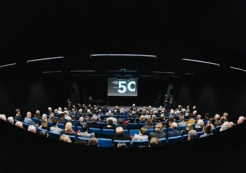
The 50th anniversary of the Lithuanian Photographers Association presented a perfect occasion for us to catch up with those who contributed to its establishment and development. Aleksandras Macijauskas is known as the key person behind the Kaunas Section of the Society where he served as a Chair for many years. In our conversation we talk about the relation between the Society of Lithuanian Art Photography and photography clubs.
Tell us about the prehistory of the Society. How did it all start and how did you get involved in it?
All the companies I had a chance to work in up until my involvement with the editorial office of Vakarinės naujienos daily, had their own culture clubs, which shows how huge the demand for cultural content was at that time. In 1963 the Kaunas Photography Club got established. I rememeber, me and Vitalijus Butyrinas showed up to sign in on the same day. I had two teachers at the Club: Povilas Karpavičius and Rimgaudas Maleckas. The latter, when I showed him my first works, unscrupulously called them "shit". Meanwhile Karpavičius used my first solo show at the Kaunas Public Library as an example as he explained his students from S. Žukas University about what bad photography was. Even though I had a difficult start (on one occasion, enraged by criticism, I even burned down my works), the Club was the place where I gradually acquired a lot of useful experience. I loved both of my teachers dearly. In fact, we were all shaped by the culture clubs, and Antanas Sutkus took us as an already formed material. These clubs changed the lives of many an artist.
As far as photography is concerned, it grew on me because of my character. The art theorist Margarita Matulytė described me rather poignantly: a heretic. During my bazar sessions I never gave in to fear, even when threatened with physical violence.
Could you tell us about how the Society came together?
It was a time of war because one fraction of photographers was against Sutkus' idea that we needed to operate independently from the workers unions. They had Birutė Orientaitė as their leader. Her bannerman was Rimantas Dichavičius who became highly respected in the photographic community at that time. I was gaining recognition and popularity as well, so I received multiple offers to go work with her, and for that I was promised some deficit photographic paper. Others received similar offers as well, but, being Sutkus' devotees, we are not easily bribed.
How so?
I think, many people were motivated by the same need to remain independent. A director of any union could have easily provided us with the necessary premises for our works and shows, but Sutkus offered us to manage everything by ourselves. We were allowed to do this with the condition that we will be self-reliant. Sutkus was quick to create an independent economy, for which he was often praised as a 'talented capitalist' by the guests from abroad. I am absolutely convinced that, if money were a priority for him, Sutkus would have become a millionaire. Even when he was forced to leave the post of the Head (1990--1996), he managed to create his own company and made some decent money. Needless to say, during the period of his leadership, the Society members were benefiting from free trips to the Nida Photography Seminar as well as various technical provisions for photographic work.
In 1973 you briefly worked in Vilnius. What made you return to Kaunas?
I should probably start by saying that I have worked since I was 16. In other words, for me, a job is something that needs to be done, whether you want it or not. So I noticed that, when Sutkus once went to Moscow (as he often would, to do some 'political maneuvering' for the Society), the whole personnel changed immediately: going on endless coffee breaks, leaving their jobs unfinished, etc. I barred this kind of behaviour, so, upon Sutkus' return, there were people queuing up outside his office. People were obviously eager to complain about me. Because Sutkus did not want to lose me, we agreed that I would move back to Kaunas, which would save me from the potential vengeance and slander. I was honestly very happy about this decision.
What were the relations between the sections after the establishment of the Society?
The relations were good. We were also friends with the sections in Šiauliai and Panevėžys. Most of the members were benevolent and willing to help despite creative conflicts. I remember how Romualdas Rakauskas would publish his harsh critique of my work in Nemunas magazine, to which I would respond just as harshly. So it is not surprising that foreign curators and theoreticians saw us as two opposite poles. But I will also say this: we were keen to argue, often rather bitterly, but I stil am proud of my colleagues because I consider their creative work as strong despite my personal aesthetic preferences. For example, Antanas Dilys was so dedicated to his work that he used to spend his own money to buy cameras and other the necessary equipment that other members needed.
We always tried to be collaborative with photographers from other countries as well. Before the Society, thanks to Vilius Jasinevičius, we were able to hold our shows in Moscow, Leningrad, Poland, Czechoslovakia, and Latvia, while foreign photographers were able to constantly visit us here in Lithuania.
How did you manage to send the works for the exhibitions abroad? How did you manage to get past Glavlit [the official censorship and state protection organ of the Soviet Union; T.C.]?
It was Vitalijus Butyrinas who used to take the biggest risk. He would produce a special list for the censorship that was then approving or rejecting the works set to be sent abroad. By that time, it was already possible to send the works by bringing their list straight to the post office. Butyrinas often produced one list for the censorship, while having another list with entirely different photos ready to be sent. Unfortunately, this kind of maneuvering eventually led to him losing his job when one day we received a catalogue from abroad that contained the pictures rejected by Glavlit.
I remember one particular story: in 1973 I received the main prize called "Golden Eye". So it happened that my photo series "Bazar" that was published as an album was deemed 'unacceptable for a socialist citizen’. So I went to see Antanas. As soon as I walked through the door, I heard him angrily talking on the phone. I immediately gathered that he was talking about me. Apparently, this ill-fated album has been sent to the Journalists Union in Moscow. In order to get away with it, it was necessary to convince Moscow not to contact the Lithuanian government, otherwise it would have led to us losing their trust and being punished. So guess what, Sutkus invited the Moscow culture representatives to come visit us in Nida and evaluate the quality of our photography for themselves.
What was the biggest challenge during your work as the Head of Kaunas Section?
After the Independence, we had to defend the gallery and prove that it was worth keeping. This was a question of life and death.
Back in these days, the whole Kaunas centre was ruled by mafia, and the police was virtually dysfunctional. One day I found Kaunas Photography School building occupied with a suspicious-looking crowd of people. I was not allowed to enter, so I went outside and saw the head of Kaunas Old Town mafia. He told me that the whole building will be blown up if we won't give it to them. So I told him: "Why would you want to blow-up a piece of architectural heritage? It will take you another five years to restore it." We then arrived at a compromise: the small gallery in Kumelių street was used both as a slot machine space, and a gallery. So the gallery and the School were saved.
What would be your wishes for the current Lithuanian Photographers Association?
I hope it breeds individualities. They are invaluable in both creative and organisational work.


