

How a Show Nearly Drowned in Lake Galvės: An Interview with Povilas Sigitas Krivickas
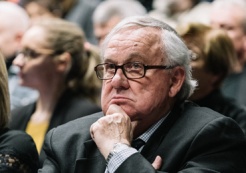
The 50th anniversary of the Lithuanian Photographers Association is a perfect occasion for us to talk with those who contributed to its establishment and development. We discuss the early days of the organization with Povilas Sigitas Krivickas—author, photographer, and a co-founder of the Society of Art Photography.
Could you tell us about the prehistory of the Society? Were you supported by the people from other disciplines as well?
In 1968 and, particularly, in 1969, as part of laying the groundwork for the Society, photographers tried to amass the support from all the journalists who worked in the daily newspapers Tiesa and Komjaunimo tiesa, as well as the weeklies Literatūra ir menas, Kalba Vilnius, and Nemunas. This was an attempt to instill some positive connotations about the art of photography into the heads of the hard-nosed bureaucrats.
It is worth noting that photographers were already showing organisational initiative even before the establishment of the Society. In the summer of 1968 they managed to organise the show by the great Italian photographer Carlo Mario Garuba who was also the first westerner to hold an exhibition in the then Art Exhibition Palace (curr. Vilnius Contemporary Art Centre). The same year saw the opening of the Panevežys Club of Photography with Lionginas Skrebė as its chair. And in October 21-25, 1968, Šiauliai Club of Photography chaired by Antanas Dilys organised their first "Week of Photography", an event that involved lectures, discussions, and meetings with notable photographers.
I can tell you a story that illustrates a photographer's dedication pretty well. In 1965, during the 25th anniversary of the Lithuanian SSR, the authorities allowed us to hold a big photography show in the main hall of the Trakai Castle. The event was the first of its kind. It featured custom designed display mounts with the artworks glued onto the sheets of glass. The artworks looked stunning, but these packs of five 50x60 cm sized sheets were so heavy that we could barely move them. Me and Algimantas Kunčius drove the heavy load to Trakai and loaded it all into a boat because, at that time, we still had no bridge joining the islands with the shore. When we rowed far into the lake, the wind suddenly rose and high waves started falling over our boat. At one point we thought that the whole exhibition was doomed to go down to the bottom of Lake Galvės. We barely managed to reach the Castle island and transport them safely to the grand hall where the show had finally taken place.
What do you remember from the time the Lithuanian Photographers Association (until 1989—Society of Photographic Art) got established?
I have got a vivid recollection of one particular October evening in 1968. We were working in our office that was part of the premises we shared with the Kultūros barai magazine. We were based in the three storey building at the far side of the Jaunimo (curr. Sereikiškių) Garden. This building served as a temporary refuge for the whole Ministry of Culture while its original building on Basanavičiaus Street was being redeveloped.
So on that notable evening we managed to summon the Minister himself who, conveniently for us, was based right above our floor. We wanted to discuss the organisational identity of our photographic movement. Many participants of this improvised 'round table' were suggesting us to join the Artists’ Union and form an entirely new subdivision of Photographic Art. Furthermore, we already had a lot of support from some of the big names in the Union, plus the Union itself was considered a respectable organisation in our cultural landscape. Finally, after having patiently heard out our slightly incoherent ramblings, the Minister Lionginas Šepetys said: "If you join in with someone else, you will always remain the 'poor relatives'".
At that time, establishing the Society of Photography seemed impossible, and the offs were against it. After all, you had no precedents in the whole Soviet Union. What were your duties right after the impossible had finally happened?
Indeed, according to the Party canons, one needed Moscow's permission to set up an individual creative union. It felt utopian to even think about getting such a permit, so we restricted ourselves to the status of ‘amateur society’.
However, lo and behold, on October 8, 1969, the Central Committee of the Lithuanian Communist Party approved the request to establish the Lithuanian Society of Photographic Art, and on November 19 the Society had its first board meeting.
The first order of business was to prepare the Society’s statute according to all the legal requirements. Some bits were copied from the Artists Union statute, others—from the documents of other creative unions and organisations. Then we had to get this document signed and approved by the Workers Union Centre, the Comsomol Centre Committee, and the ministries of Justice and Culture. After all these preparations, the project was sent for approval to the Central Committee of the Lithuanian Communist Party.
In 1971, as part of the expansion initiative, the Society had established its branches in Kaunas, Šiauliai, and Panevėžys. In 1973 we saw the opening of the Vilnius Gallery of Photography, and in 1979—Kaunas Gallery of Photography.
The Art Council was set up right after we started organising our first shows. The first question that the Council had to discuss was the preparation and transportation of our shows to France, Yugoslavia, and Hungary. Every photo needed to be inspected by Glavlit (the soviet censorship organ) and approved by an official at the Ministry of Culture—only then photos were ready to be sent abroad. Some photographers used to bypass these checks. However these practices were posing a threat not only to the individual photographers, but to the Society itself. The Art Council was forced to be strict about such transgressions. We have a protocol from January 6, 1971, "considering the behaviour of Vitas Luckus" who was reprimanded for this kind of "misconduct".
What other activities was the Society involved in?
It was publishing that became one of its priorities. From its very first steps, the Society considered having its own periodical. I recall one failed attempt at this initiative. After going through a host of photography-related terms, we settled on “Objektyvas” (“the lens”) as a title. The term seemed to tie both art and technology together, and it had a connotation of objectivity. So we had all the pictures and articles ready for its pilot issue that was scheduled to launch in the autumn of 1971. Unfortunately it did not even reach the printing press. According to the soviet regulations, the whole material had to be revised and approved by the Culture Department of the Central Committee of the Lithuanian Communist Party. Antanas Gedminas represented the department at that time, and it was his fateful "no" that had put an end to our initiative. Gedminas, an artist-turned-official who was always supportive of our Society, was obviously succumbing to the pressure of authorities, and it is still unclear what got them so frightened. However the material intended for Objektyvas did not lay dormant in the drawers. We published it in other periodicals instead. Some years later we eventually launched our own biannual periodical Fotografija (Photography).
The Society has always been paying a lot of attention to education as well. The Nida Photography Seminars were running since 1973, which makes it to over forty annual events for Lithuanian photographers. At first it was called a “seminar”, then it was changed to a "photo-academy", and today the event is known as a “symposium”—a term that, perhaps, most accurately reflects the essence of the event. Along with the exhibitions, it offers lectures, meetings with artists, discussions, and book launches. All in all, photographic art has been actively cultivated for five decades now.


