

Carolle Bénitah: I was constantly telling myself, “I don’t want to be gentle”
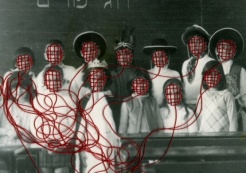
The French photographer Carolle Bénitah works closely with her family’s albums, exploring shifting identity and reconstructing memories. “As Louise Bourgeois once said, ‘Every day, one has to get rid of one’s past’. For that purpose, there are two methods – either we throw everything in the bin, or we recycle. I choose transformation. This constitutes the basis of my plastic language.” The Lithuanian Photographers Association is showcasing her photo-series Photo Souvenirs. For the occasion, we present you with an interview with the artist, whose intimate projects expose the unconventional themes that we often tend to hide.
Until 2001, you worked as a fashion designer. How did your interests shift towards photography?
I was very interested in fashion photography because I think when I saw some works by really great fashion photographers such as Norman Parkinson, David Bailey or Frank Horvat, I thought to myself I really have to do something with that. But it’s not so easy. You need to have clothes, a model, a make-up artist and so on, so I started reading about photography in general, visited many exhibitions, and after some time started depicting my own surroundings.
I had some very difficult times back then in my personal life, so photography in some way helped me understand what was happening. I got accepted to university to study photography and so I didn’t want to go back. Actually, during the interview at the university, the jury offered me to publish a photobook almost immediately after seeing my work. It was almost as though the decision wasn’t made by me, like a game with dice.
In your photobook, you say that these fragments (meaning photographs) of your past are like confessions. Would you agree that your photo-series is a personalized diary?
Yes, it was like a retrospective work to understand why I had such a difficult time. Back then I was living a textbook happy life, and I was even supposed to appreciate my life, but I couldn’t. So, one day I was looking at my family album and suddenly it felt like I was looking at it completely differently. I saw the pain and sorrow. Then I started trying to express what I was feeling at that moment while looking at each picture. It was like reflections of the past experiencing the present.

Would you say that photography in general is in some way about that?
I think photography is about the moment that no longer exists. But we need to leave something of us behind, like memento mori. Also, it helps to create your own world, like a new life. And photography – also art in general – is general. Even in my project I’m not talking that much about myself as much as expressing some universal emotions.
With Photo Souvenirs you are breaking some stereotypes, because we are used to talking about ‘family’ as such in a very positive light.
Exactly. While creating the works I was constantly telling myself, “I don’t want to be gentle, I don’t want to be gentle”. And it was as difficult for me as it was painful. But it was a matter of life and death, because I just had to do it. But I think that if you want to have a better life you have to face some difficulties sometimes and do your own thing. It’s like in psychoanalysis, you have to say a word, and I had to say it.
Another subject in your works that draws my attention is femininity and women’s roles as wife, daughter or mother.
Even though I’m not a radical feminist, I use it in my works as a tool that helps me to express how I see myself. I think feminism is an important subject to talk about because we represent half of the population. And I understand those who oppose it, because when you have power you don’t want to lose it.

Do you feel the difference being a woman artist?
If you are a woman and photograph your family, as in my case, it’s considered as if you are domestic person and it’s not so interesting. But when a man depicts his relatives, it suddenly becomes very personal and it’s like he shares his vision and point of view. I find this treatment very unfair.
Also, women are not represented enough. Until Les Rencontres d’Arles this year showcased only 20% of women artists and only because of the protests, manifestos and so on, this year the percentage of women artists increased to 46%.
I was wondering, what role do archives play in your art?
Now it’s taking place more and more. From 2009, I was making two series that were based on my archive. Then I did two more series from my ID images. Now I’m making a series where I build a fantasy photo album from found pictures. I try to rebuild my parents’ photo albums, but here I cover the people’s faces with golden leaves that reflect the viewer’s gaze.
Also, I’m currently working on a project about the rituals of marriage using bank images. Some time ago there was a protest in France because there was a new law that allowed homosexuals to get married and some conservatives were protesting against that. So, I was wondering, why do people want to get married nowadays? And I started collecting everything about the rituals of marriage because it doesn’t matter what your sexuality is, people are still hooked on traditions.

Do you usually work alone or have some people or organizations influence your production of your works in some way?
I think an artist can’t do everything by him/herself. I think everyone has to have a close and understanding community if they want to produce the best-quality works. Every step that leads to an exhibition, photobook or whatever is very important.


