

An Interview with Milda Šeškuvienė
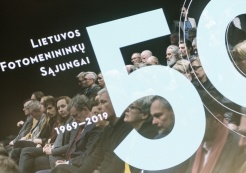
The 50th anniversary of the Lithuanian Photographers Association is a perfect occasion for us to talk with those who contributed to its establishment and development. This is our conversation with Milda Šeškuvienė, a member who took an active part in organisational activities during the 1980s.
My work with the Lithuanian Society of Art Photography began in 1980. I got interested in the art of photography few years earlier, when, during my work as a school teacher, I could not help but notice that the works of our photographers resonated closely with our literature. Not to mention the popularity of these striking portraits of our writers. I think this once intimate relation between artists is no longer there. In the face of soviet terror, the spiritual connection between people was stronger, and you could actually feel this mutual support which, because of its covertness, remained largely undocumented and eventually forgotten. Creativity was like a hole in the thick layer of ice that allowed us to breathe. I was particularly moved by how much photographers respected our writers, theatre directors, musicians, and artists.
Even ten years after the establishment of the Society, these self-taught photographers still felt inferior to other art professionals (during all the major art conferences Sutkus never missed a chance to argue for the necessity of teaching photography at the university level), however not because they were hesitant about the quality of their own work, but because of how their situation was perceived by the society—after all, even artists could not exhibit if they had no university qualifications. Thus they had to prove, over and over again, that, artistically, photography could be just as valuable as a piece of painting, and that the photographers themselves were not merely craftsmen, but artists. At the peak of their creativity, all these talented and ambitious artists such as A. Sutkus, A. Macijauskas, A. Kunčius, R. Rakauskas, V. Luckus, as well as R. Požerskis, V. Šonta and others, who were younger but just as creative and active, were bursting with energy and desire to show their worth to the world. This was a truly inspiring and electrifying environment to be in. The Society used to be covered with heaps of exhibition-ready prints: the material for exhibitions and selected collections to be sent off to the shows, competitions, and publications abroad.
Our photographers had numerous achievements. V. Butyrinas even had a world map covered with pin flags to represent the places where his works ended up in. Instead of being complacent with their achievements here, they grabbed on to even the smallest possibility to take part in the shows abroad, which allowed them to remain informed and critical. Indeed, the restrictions were abound, but there were just as many ways of bypassing them. While some might accuse Sutkus and his colleagues of pandering to the soviet authorities, I think that, instead of merely working on the state commissions, they were manipulating the authorities so that they could get their artistic work out there. Restrictions are not necessarily the ultimate obstacle, they might actually stimulate creativity.
The Society was drawing photography aficionados from all over the republic and abroad. There used to be hundreds of people signed up for exhibitions and seminars. Sometimes our visitors simply asked for permission to access our library and look through our archives. We used to have plenty of events and visitors.
Organising Nida Seminars was one of the central tasks. We'd start our annual preparations well in advance, leaving ourselves over six months for the task. The key priority was inviting interesting theoreticians and authors from abroad. Our seminars used to be attended by many Lithuanian and foreign luminaries: philosophers, art theorists, and scholars from the Moscow Institute of Art History. Many of them authored multiple texts about the Lithuanian school of photography. From today's perspective, some of these works are of dubious quality, while others—for instance, L. Aninsky's book—are really interesting and present us with important discoveries. Even though Nida seminars would last only ten days (and sleep usually took up only a small fraction of this time), they had an intensity of the entire university courses. Apart from the lectures, each day would have around ten panels on various official collections, not to mention the individual work in all the rooms, corridors and all other available spaces. The prominent art theorist A. Andriuškevičius told us that he once even took refuge in the forest as he tried to hide from a pesky photographer who insisted on hearing his opinion on her works.
These seminars would always give everyone a lot of things to think about. We'd also set up a library in Nida so that everyone could get access to those precious books we amassed. Senior colleagues were eager to share their experience, and A. Macijauskas would often work as a consultant. Our photographer's library had a great success among artists because we had many albums you couldn't fine elsewhere. But this is a separate topic. The key thing was that those seminars gave everyone much more than any exhibition ever could because, apart from the officially authorised list of all the participants, we did not need to get those "Authorised by Glavlit" stamps on each and every print we were showing there.
There was one time when Boris Mikhailov did not get the permission to go to Nida. We knew his works to be exceptionally brave and original. Today he is an internationally renowned photographer. So he went to Vilnius and visited Luckus instead. However, right after the seminar was over, we arranged a meeting with Mikhailov in the painter A. Kuras' workshop, and many people still remember this memorable event.
Luckus was a popular host not only because of his prolific creativity, even if many of his works never left his house throughout those years, but also because of his charisma and energy. So his house was always full of guests. He was also good at resolving all kinds of 'situations'. Once, during one of the seminars, a guest from Moscow told me that he would have to write in his report that we were not adhering to the obligatory norms of soviet citizenship, so the seminars would have to be discontinued. This got me really scared, so I called Luckus who then invited this 'guest' to his house where, after some ample regaling, they had, as Luckus said, a "man-to-man" chat. I don't know what really happened there, but there scandal was prevented.
It was during the Nida seminars that our colleagues had a proper chance to see Luckus' works. Luckus took this very seriously—he framed a few hundred of his prints, rented a tow dolly to bring them all there. The debates were really heated, even to the point of me trying to prevent men from fighting. The author was taking the criticisms to his heart, while there were always the less talented ones who were quick to scold him.
Anyway, these seminars were open to all opinions. We had no virtual space, nor any possibilities to go and see the world abroad, so we had to learn directly from each other. We'd even call ourselves the Society of the Art of Communication. It was fun working there. We'd rush to work every day not because of the working hours, but because there was always something interesting happening there.
Photo by Domas Rimeika


