

How to Create a Community: An Interview with Jonas Staselis
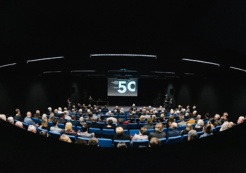
The 50th anniversary of the Lithuanian Photographers Association is a perfect occasion for us to talk with those who contributed to its establishment and development. Jonas Staselis is a former Chair of the Association and we talk about various aspects of its work.
How did you come to work at the Association?
It was at the end of 2008 when Antanas Sutkus invited me to take part in the elections for the Chair of the Association. He had been following my activities at the Press Photographers' Club where I was a chair at that time, and he said that the Association could certainly benefit from my experience. I was very happy that Stanislovas Žvirgždas decided to stay in the Association after I became a Chair, this certainly had a positive impact on our team.
But then, after my becoming a chair, Lithuania fell into financial crisis. This caused us to lose many partners, and our functioning was severely impeded, but we managed to survive nonetheless.
What were the first things you did after you became a chair?
I am not exactly a revolutionary, but I realised that some changes had to be made. I am thankful to Žvirgždas who helped me to better understand the situation and introduced me to the nooks and crannies of the Association.
One of my main goals was to allow the non-members to work with the Association. I think, this organisation is supposed to represent the whole field of Lithuanian photography, independently of the organisational membership. The first step was to enlarge the visibility of the Nida Photography Seminars. One of the innovations was the synchronous interpretation into and from English during the presentations. We also created a more dynamic programme. For instance, we would open the shows during the seminars so that the guests would have a chance to get better acquainted with the artists and their work. This was how "Nida Off" programme was born.
As part of our gallery work, we launched the "Debut" competition which we made open to photographers from all over Lithuania, irrespective of their membership status. Our almanac (Lithuanian Photography: Yesterday and Today) was made more open as well.
We sought to turn Vilnius Gallery of Photography into a space where young artists could build their own community. Unfortunately, this idea was not fully realised because of the sheer lack of time. Meanwile we would put 3-4 annual shows of classical photography art in the "Prospekto" Gallery, which served as our main space representative of our work.
In your experience, how important is the organisation to its members?
Here I happen to remember a conversation with Gintautas Trimakas four years ago. To mark the anniversary of the 40th Nida Photography Seminar, we had an idea to publish the participants' memoirs about this event. So Trimakas told me that, each time he made a new series of work, he would turn back the clock and acknowledge the extent to which his creative achievements were largely a result of all the feedback and debates during the Nida Seminars. This would be a great example of the importance of our organisation for the major players in this field.
What were your biggest achievements and mistakes as the Head of the Association?
The creation of the community of artists is definitely among one of the biggest achievements. Today image making is a highly competitive field, and we have to assert our values and creative principles by sustaining a lively community of artists.
On the other hand, in order for an organisation to function, an inner harmony is necessary. Alas, at some point the latter got lost and the institution got unbalanced. This would be my biggest mistake and I take my responsibility for it.
What would be your wishes toward the further development of the Association?
I hope that the Association will remain in the leading position among the organisations that represent Lithuanian photography. I wish current members will be able to resist the tendency of becoming 'cliquey'. Whichever way the organisation will develop, it will do well as long as it stays on its path and keeps growing. They say that today creativity is the only thing that makes humans competitive in relation to A.I. And, as far as creativity is concerned, Lithuanian photography surely is competitive.


