

Depicting the Undepictable
How can we depict and narrate what human beings cannot fully imagine? This question was raised by Amitav Ghosh in his well-known 2016 book The Great Derangement: Climate Change and the Unthinkable.[1] The Indian writer called the current transformations of Earth and humanity – global climate change caused by anthropogenic activity – a phenomenon so vast in scale that traditional thinking deranges and the cultural imagination becomes incapable of grasping it. So the primary question of Anthropocene aesthetics concerns what can be imagined and what can be represented. One might say that the consequences of global warming and pollution are best understood through science – ecological theory or the research results presented by climate scientists: rising numbers and ascending graphs. But can they move us emotionally? The ‘real’ documentary image brings us closer to understanding what it means to live in the era called the Anthropocene: satellite images record global changes, while (audio)visual arts reveal what lies behind the numbers and force us to feel the climate crisis. In Lithuania, discourse on the Anthropocene emerged in the second decade of the 21st century. The ‘Anthropocenic turn’ in the arts typically involves highlighting and reflecting on topics such as the relationship between humans and nature, humanity’s impact on planetary life processes, climate change, the mass extinction of species, bioethics, ecological threats and disasters – and the struggle against them. So let us first look at what themes dominate the field of Lithuanian Anthropocene art.
***
The artists of the past decade working with ecological themes have been concerned with both local environmental questions and global problems – climate change and ecology – affecting all of humanity or communities in other countries. Artists explore hyperobjects[2] historically related to Lithuania, such as the Soviet-era energy infrastructure (oil and gas pipelines, nuclear power plants) and environmental pollution by petroleum products; waters (hydrological issues of peatland drainage or water pollution); forests (dendrological themes of deforestation). For example, in their ongoing project Druzhba (since 2003), Nomeda and Gediminas Urbonas have investigated the oil pipeline as a hyperobject, while Emilija Škarnulytė, in her film Burial (2022, 60 min.), focused on the Ignalina Nuclear Power Plant. Other projects – Aurelija Maknytė’s Partisan of Landscaping (2013), the Urbonas’ The Swamp School (2018) – address hydrological themes of land reclamation and aquatic life. Dendrological forest preservation is the theme of Mindaugas Survila’s documentary film The Ancient Woods (2017, 85 min.) and Andrej Polukord’s performance and photography project Woodstatues (2021).
Artists depict global ecological transformations – the transformations of nature visible in different parts of the world and the places on the planet most affected by a warming climate. Such works include the Urbonas’ peatland research, Škarnulytė’s video films and installations Song-Do (2013, 11 min.), Sirenomelia (2017, 12 min.), Aphotic Zone (2022, 15 min.), Æqualia (2023, 9 min.), and Riparia (2023, 10 min.), as well as Kotryna Ūla Kiliulytė’s series Arctic Swell (2020-2022). These works address not only global issues – melting glaciers, ocean pollution – but also local peatland ecosystems. Knowledge of post-industrial Western and post-colonial Asian and Latin American environments and the communities living within them allows artists not only to reveal their ecological problems but also to better understand the consequences of Soviet modernization and the capitalist system.
Another field of Anthropocene art focuses on the relationship between humans and non-humans, with the growing understanding that nature can no longer be regarded solely as a resource or object for human use, nor divided into separate parts without losing the essential interconnectedness of many of its elements as an intra-active vital symbiosis. Artists explore how humans, animals, microorganisms, plants and minerals intra-act within the biosphere and geosphere, drawing attention to the distinct worlds of (micro)organisms. One of the earliest examples of such artistic research in Lithuania was the Urbonas’ project Zooetics Pavilion (2015), and in recent years similar works have appeared more frequently. These include Aistė Ambrazevičiūtė’s Plantasia Lab (Lichen Grammar, 2024), Indrė Spitrytė’s sustainable textiles created in Algae Lab (2022-23), Simona Rukuižaitė’s geopigments (the exhibition Foundations, Artifex, 2022), and Ieva Maslinskaitė’s micro-communities (the solo exhibition to inhabit dryness, Vilnius Photography Gallery, 2025).
The possibilities of traditional plastic expression to convey the scale of today’s ecological catastrophes are in part limited, yet the problem lies not only in the image itself but also in its scale – what is being addressed is simply too vast, an overwhelming reality. From art history we know powerful works that depict apocalyptic end-of-the-world scenarios with great impact, yet today such artistic language no longer creates an illusion of reality – it lacks documentary evidence, sensationalism, emotional force. In Ghosh’s view, global warming is, overall, ‘resistant’ to art. Consider the vocabulary, he says, associated with fossil fuels – ligroin, bitumen, oil, tar. No poet or singer could make these syllables sound light or appealing, while the materials themselves – coal, the stench of soot deposits, viscous oil – act as something repellent.[3]
The French art critic and curator Paul Ardenne emphasizes that what affects today’s viewer is a ‘non-mannered’, ‘full-bodied’, ‘pulsating’, ‘permeated’ image of potential catastrophe – anti-artificial image[4]. Such an effect is most successfully achieved through a ‘documentary’ visual language. The scenarios of catastrophes caused by global warming are photogenic and cinematogenic. In Anthropocene imagery – documentary simulacra of reality – we see not an artificial or artistic vision of a frightening and unsettling imaginary post-catastrophic, post-natural future. Photography and large-scale video installations that bring closer, enlarge and accentuate deformations of the natural environment allow the viewer to visually experience global transformations, at least to some extent.
The question of ‘representability’ also arises because many Anthropocene threats – global warming or other ecological disasters – are concealed: invisible, externally unmanifested catastrophes ‘without event’.[5] Narratives about climate change often lack a concrete scenario: there is no clearly identifiable force that has caused the global disaster, nor a specific place or time. Thus, the latency and indeterminacy of the phenomenon shape how it is represented. Unlike momentary threatening natural or atmospheric phenomena, global climate change does not become an ‘event’ whose totality a person can experience and comprehend.
In the aesthetics of the Anthropocene, issues of entanglement and large-scale phenomena are foregrounded, as it is increasingly understood that humans are deeply embedded in the network of planetary life, and that nature is not merely a resource or object at humanity’s disposal, nor can it be divided into separate parts without losing the essential interconnectedness of many of its elements as an intra-active vital coexistence. Artists reflect on the intra-active relationship between humans and non-human beings, visually illustrating that animals, microorganisms, plants and minerals are not isolated entities but intertwined parts of the shared biosphere and geosphere. Everything that is non-human and threatened by human activity becomes a subject of artistic creation. Questions of geological time, global space or the massive, planet-altering scale of forces are contemplated visually by juxtaposing different scales: for example, the brief duration of a human life with geological time, a local phenomenon with global transformations, or by multiplying individual actions a billion times and showing their impact on the climate.
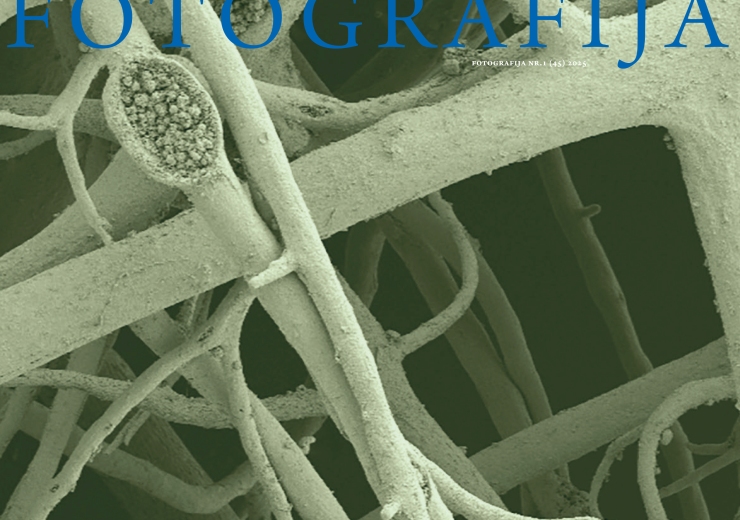
The medium of (audio)visual image and sound partly helps to overcome the problem of representability, using anti-artificial, large-scale imagery. When creating photographs, video installations or films, artists incorporate different scales in various ways. This may involve a large format for photographs or (video) installations (for example, Škarnulytė’s Chambers of Radiance (2022-2024)); the creation of macro-images of small objects or microorganisms; or, conversely, the enlargement of massive objects. Ambrazevičiūtė creates macro-images of lichens, mosses or fungi (video installations Dzūkija (2021), Forest Tectonics (2020)). Ieva Maslinskaitė cultivates and photographs micro-communities – fungi, bacteria – in Petri dishes, creating mutating installations, sculptures and photographs (to inhabit dryness, Vilnius Photography Gallery, 2025). Škarnulytė (video installation Chambers of Radiance, film Burial) brings large industrial structures close to the viewer’s gaze, transforming them into impressive technological ornaments. To reveal scale, top-down views are used, allowing us to look at the Earth through the eyes of a non-human being – a bird. Kotryna Ūla Kiliulytė (Arctic Swell, 2020-2022) captures human and non-human interaction by looking through a microscope at a woman’s body cells and Arctic lichens, sculptures made of seaweed, while the digitally reconstructed Arctic forest is viewed from a ‘bird’s’ (drone’s) perspective. Different temporal scales – the long history of the Earth, geological time (deep time), and a post-catastrophic future – are highlighted through allusions to ancient myths and legends. Škarnulytė incorporates them into works such as Sirenomelia, Aphotic Zone, Hypoxia (2023, 12 min.) and Riparia. Fictional posthuman beings, embodied by the artist herself in performances, dive in post-catastrophic ‘eventless’ waters of the future.
‘Documentarity’, scientific grounding and interdisciplinarity are characteristic of Anthropocene aesthetics. Artists, together with natural scientists, record geological and biological transformations of the Earth, narrate the consequences of the climate crisis, and draw attention both to global narratives and to local experiences and the smallest elements of nature. Contemporary biotechnological artistic experiments mark an ‘ontological turn’ in art. They merge with the natural sciences, exploring natural materials and microorganisms, experimenting in photography, architecture, textiles and other fields. The result of artistic investigations of nature takes the form of scientific laboratories researching fungi, algae, lichens, trees and other natural organisms, or artworks resembling pavilions, schools or natural science museums – installations and video/photo-installations in which art becomes nature. Artworks do not depict nature; nature itself inhabits the artwork.
The active transfer of nature into art museums and galleries is a symptom of the increasingly deep alienation and anxiety within contemporary Western societies – between humans and their non-human environment, between the worlds of culture and nature. This solastalgia – the anxiety caused by climate and environmental change – also encourages artists to confront these challenges in their own ways. Yet we may still ask whether the aestheticisation of threats lulls our sensitivity – whether aestheticisation anaesthetises.
[1] Amitav Gosh (2016) The Great Derangement. Climate Change and the Unthinkable. Chicago: University of Chicago Press, p. 176.
[2] Morton, Timothy (2013) Hyperobjects. Philosophy and Ecology after the End of the World. Minneapolis: University of Minesota Press, p. 229.
[3]Amitav Ghosh (2016), ibid., p. 73.
[4] Ardenne, Paul (2018) Un art écologique. Création plasticienne et anthropocène. Lormont: Éditions Le Bord de l’Eau – Collectif la Muette, p. 66.
[5] Horn, Eva (2018) The Future as Catastrophe. Imagining Disaster in the Modern Age. Translated by Valentine Pakis. New York: Columbia University Press, p. 484.


