

An interview with Ieva Maslinskaitė
MM: Could you share some general information about your creative process and the techniques you use? It doesn’t have to be just about photography, although your approach to it is also not entirely conventional.
IM: I would say that my artistic practice is mostly related to photography or image-making but with an expanded understanding of photography. When creating images, I move from an anthropocentric process towards an ecocentric one. I enjoy working with photography because it has a clear technical framework: there is light, time and light-sensitive material. I find it interesting that this is a very rigid framework and am curious about how it can be shaken up and how photography can be transformed from a stationary, constant thing into a looser, ever-changing medium. In my work, I collaborate with other species and organisms, as well as processes: these are often microorganisms, different species of plants, fungi and the processes they go through, thus losing some control as a creator.
MM: As you just mentioned, in your work, you collaborate with various microorganisms and other species, nonhuman life forms. How did this idea originate? How did you come to it?
IM: Out of frustration, in a way. Of course, the ecological crisis is a looming problem that permeates everything and is also echoed in contemporary art. We are seeing a lot of exhibitions, works, and projects that address the ecological crisis in some way or seek possible solutions. Very often they are representational, especially in photography, because it is, of course, inseparable from representation. But this raises the question of how we represent nonhuman others and the environment. Yet again, we do it through the human gaze. I’ve always had an interest in how other species could play a role in representing the environment or in working with ecological issues. These themes emerged from my interest in the body: I was fascinated by all the other species that live within it. I think of myself as a network of organisms instead of as an individual being. This is the view of myself that I wanted to incorporate into my working process.
MM: At this point, I would like to go into some of your works specifically. In In a Pupa: Relearning Photography from a Nonhuman Perspective, you work with mould, fungi, and bacteria. They rework your photographs, read and rewrite books. How do you decide on the material you give these collaborators to recreate?
IM: First, regarding photos and images. I live in the Netherlands where the landscape is almost exclusively shaped by human hands; the entire country is a drained swamp, a land of polders. I have not seen a natural space anywhere else that is so tightly controlled, where everything is monitored and recorded, where you can even check exactly when, where, and what kind of tree was planted. Everything is systemised in a very specific way. So it was interesting for me to take images of an uncontrolled environment and let them be controlled by uncontrolled organisms and processes. Bacteria and fungi colonise images in my work and slowly dissolve the toxic silver layer on the negatives. This light-sensitive silver nitrate layer, found in many photographic products, has numerous connections to colonialism, extractivism, and environmental pollution. For me, it was a rather symbolic transition from toxic analogue photographic practices to more environmentally friendly ones that use sustainable materials. Apart from the image being controlled by nonhuman others, there is also a shift away from toxic materials.
As for the books, I chose the ones I would read while researching photography during my studies and later when I needed to learn about it through the perspectives of nonhuman others. I then thought I could use these books on looking that most people know, and which focus strongly on looking at other people. These books were written at a time when the ecological discourse was perhaps not such an important topic yet, and naturally, they focus on looking at humans. I wanted to see them through a different, nonhuman perspective. And since paper is a material that all sorts of fungi use to grow, a book can be interpreted as a direct source of food for other species.
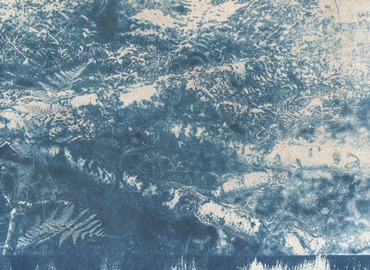
MM: In the installation Unworlded, Bewildered: On Image as an Ecosystem, you revisit the botanical regulation mentioned earlier and use glass and cyanotype. What was your reason for choosing these materials for this project?
IM: In my artistic practice, I still rethink and reinterpret old processes. Historically, botanists first used cyanotype because it is a nontoxic and rather quick way to make prints of plants. Later on, the cyanotype process started moving away from botany and towards construction, where it was used for making blueprints. For me, this shift from trying to learn about the environment to trying to control it relates to building anthropocentric structures. The majority of my work stems from experiments. I wanted to experiment with the cyanotype process simply because it is a low-toxicity method of printing and image-making. I wanted to try, as I often do, to combine it with other species, so I did a study. Cyanotype is an iron-based printing process or rather, it uses chemicals containing iron which is oxidised by some bacteria. I wanted to see how iron-oxidising bacteria could be introduced into the process of creating images and if an image could be reimagined as an ecosystem. I already see the image as an ecosystem where there is light, time, and a light-sensitive material. When I include certain nonhuman others, whose input is not as controllable as ordinary image-making, I explore what the image could look like after their intervention.
I chose to work with glass because of its similar ties to botany. Cyanotype was used to study plants, and then plants became controlled and patented; in a way, they became appropriated by man. I used glass taken from massive greenhouses that are being demolished or rebuilt in Holland and use this glass to create vessels or objects for a new process and a new image.
MM: During the workshop Microbial Selves, hosted at the arts and culture centre SODAS2123, you collaborated with your grandmother, who is a microbiologist. Did she contribute to your interest in this topic? Or was it only later that you developed a common interest in this field?
IM: It was later, actually. When I became increasingly interested in microorganisms, it was still a poetic rather than a scientific subject for me. I started looking into other ways of collaborating with organisms in art – that’s when I somehow connected with my grandmother’s practice. She has worked in the lab for many years, and of course, she has a completely different understanding of what I’m doing, and maybe sometimes it seems like nonsense to her. But when we did that workshop at SODAS, she loved the idea that somewhere there is an open laboratory where people can do something with this knowledge and apply it in some way in art or some other field, that they can act without being controlled by some kind of rigid framework, as is often the case in laboratories or in an academic context, which is something I am not familiar with, but she is.
MM:Can you tell me more about this workshop?
IM: That project still needs some work. Although the workshop did take place, as is often the case with nonhuman organisms, the results were simply not what we planned. After taking samples from other people, the microbial communities had to be cultivated and monitored for some time. But it so happened that when they were put into the incubator, all the microbial communities overgrew in maybe less than 24 hours, and it was impossible to identify them. I find that I have no control over how my projects will turn out. Therefore, this project is not fully developed. At some point, we will have to find a space and do it again - I still wonder how it could potentially conclude and what can be learned from it. Although sometimes you find out that the microorganisms living in your body are just beyond your control, and they form a giant indivisible mass.
During the workshop, I also talked about identifying microorganisms and read excerpts from Kyla Schuller's text The Microbial Self. It is about understanding the self as a community, focusing on interactions with other microorganisms. She talks about living with illness and how she sees it as living in a community with other species, being part of an assemblage.
MM: You mentioned temporality. Could you tell us more about how this relates to your work?
IM: I am in a toxic relationship with temporality and lack of control in my work. On the one hand, it's a driving force in my artistic practice: I’m very interested in temporal processes and moved by works that change over time. But at the same time, I always want to regain control. When I create a piece, it has to be shown somewhere. I want to preserve them in some way. But in a way, my practice doesn’t allow that, or it makes me always look for new ways of preserving it in different forms, of documenting the process. But I realise that capturing the process is paradoxical. I am always confronted with the question of whether the physical piece or the process is the work. These are key questions in my artistic practice. But sometimes I desperately wish I would just create a piece; it’s finished, it can be installed in a space or hung on a wall and that’s it. But this is not the case, and I like that because it’s a good challenge and working against the grain of what photography should be helps me broaden my understanding of it. At the same time, it brings up a lot of anxiety, a lot of stress, and a lot of frustration, but it allows me to reflect on why we humans want to be in control of our environment and how such small experiments and exercises can help us escape from it at least to some extent. When I create, I realise that I cannot control the environment, the whole ecosystem in which I live. I am aware that I am more than a single body and that perhaps other nonhuman factors still control me more than I control them.
MM: In your work, you also rethink power relations and hierarchies. You focus on the hierarchical relationships that emerge between human and nonhuman life forms. Are these also metaphors for other kinds of inequalities? You mentioned earlier that bacteria eat the toxic layer from the photographs that are associated with colonialism. And the term control itself, which is recurrent in this conversation, may also refer to various hierarchies.
IM: I don’t think about it much. I understand that I tend to get into things that are on the micro-scale, but sometimes I don’t reflect on it much. In interview sessions, someone would always suggest that I should rethink the micro-processes on a macro level, but I tend not to think of it as reflecting inequalities of some broader kind.
Currently, I’m looking into resources used in photography, such as silver nitrate products, and I realise that the geophysical and social aspects cannot be isolated from the aesthetic or sensory practices and that everything is connected, at least to some extent. I am particularly interested in the divide between the materials used and the human being who uses them - their metabolic connection. This was something I wanted to explore further during my residency at the Nida Art Colony; thinking about how to draw the resources you use to yourself, because it also pushes you to be more ethical.
I have digressed slightly, but I can’t say I can point to any inequalities on a broader level. Perhaps there is room for interpretation by the audience and other people with different perspectives.
MM: Since you mentioned Nida, how was your residency at the Art Colony? What was your creative process like while staying there?
IM: It was a short residency. The time went by so quickly–I spent about a month there. But it still felt very condensed to me. Living in the Netherlands and working in the city, I often feel that I don't have enough context to work in, especially the ecological context. I feel like a resident in a neoliberal utopia where I can do anything. Even in terms of producing the artwork, I can go and get the precise materials I need. All the tools are there. But what I lack is a space where not everything can happen, so that I can work with the local context. This residency in Nida is that kind of place. In the Curonian Spit, if you need something, it’s not so easy to get. And that creates a kind of challenge.
There was a lot of walking during the residency, and walking is also a research method of mine, in which I try to explore and map out my surroundings. I took a DIY, a do-it-yourself approach, trying to source the products used for photography from a local context. For example, I used the leftover wood and sawdust found at the Colony to make paper that could be used for photographic printing. I also made all sorts of paint and light-sensitive emulsions, mostly from pine trees, fallen lichens, and weeds. Collecting plants and other materials in the forest must also be ethical. For example, you can’t just pluck lichens off trees that have been there for twenty years; you have to wait for a storm to collect them.
There was just an awful lot of experimentation because I first selected the materials and then figured out what could be done with them. Or, for example, knowing how paper or natural dye emulsions are made, I could try to make them using the materials that were available to me. All in all, the whole residency was an investigation of materials from a local perspective and an exploration of how they could be used in photography, as well as how an image could be brought closer to the local context in which it was made.
What the works themselves looked like was also quite interesting. I was wondering whether there was too much control on my part as a creator compared to the other works. Nevertheless, how the works look–their aesthetics–is ultimately controlled by the materials and ethics.
MM: Even though you have mentioned the difficulty of controlling the results of your work, could you describe, or at least predict, what the results of this residency might look like when they are presented in autumn?
IM: Compared to all my other projects, I believe the results of this residency will be the most photographic. It will be mostly prints made with the materials I created in Nida: emulsions, paints, and paper. I also have various other experiments that were created with local materials. In addition, brought my old photographic products with silver nitrate, such as photographic paper, and made prints using seawater to fix them. It was a less toxic way of fixing the images.
It will be quite photographic, quite analogue, and subtle. But I was simultaneously a kind of archaeologist of photography, using the processes of analogue photography, but reading them in a different way and through different materials. For me, the movement towards analogue practices, which has been going on for a while, represents a return to handicraft. I like that too–it keeps me somewhat grounded and in context. But right now, I’m still primarily interested in working with that analogue, physical photography from a more ecological or ethical standpoint, and am figuring out how to anchor the images in their immediate material sources, to fill that ‘metabolic gap’.
MM:And how did you choose this particular residency? How is it different from other residencies you have been to and worked in?
IM: I like to come back to Lithuania through residencies. It was the same with the The Spinners residency, because, as I mentioned, it provided a context for me to be in. Whereas in the Netherlands I feel I am in a decontextualised space or maybe just foreign to it. It could be asked whether I should be there at all, but I won’t go into that now. One thing is that these residencies make me feel some kind of belonging. It also gives me opportunities to work with the local context in a more material way; opportunities to be outdoors, to walk around–that’s a big part of my process. I’ve already mentioned that I like the constraints of residencies and that I need to work within the context that is already there.
This residency is more concerned with photography per se, and thus it focuses on more photographic results. In some residencies, this outcome is completely unnecessary. And I would say that in this residency the participant is free to choose individually whether they want this result or not. But for me, it has worked very well within my artistic practice. Even though it was short, I feel that I took quite a lot from the research and that there are still some small conclusions to be drawn.


